
- 5+ years of home healthcare experience
- Background-verified clinical staff
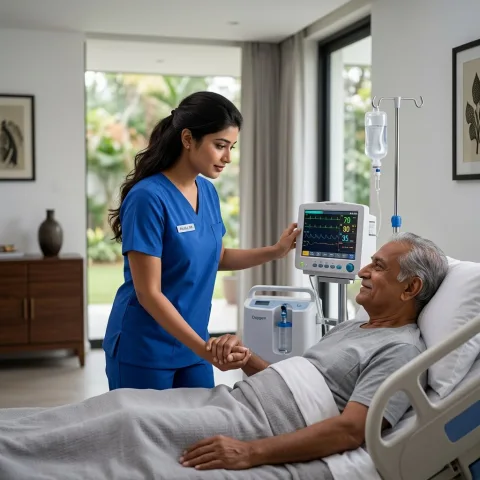
Medca Healthcare provides ICU care at home in Bangalore with critical care-trained nurses managing ventilators, cardiac monitors, infusion pumps, tracheostomy, and multi-organ support — including 24/7 nursing shifts, equipment setup, and physician-coordinated emergency protocols. Confirm your Bangalore pincode during enquiry.
Near You
ICU Care At Home in Bannerghatta Road
Professional icu care at home available in Bannerghatta Road (560076).
-
 Sub-service
Advanced Nursing Care
Advanced Nursing Care at home in Bangalore by a Medca nurse, as part of ICU Care At Home.
View sub-service → -
Sub-service
Critical Care Monitoring
Critical Care Monitoring at home in Bangalore by a Medca nurse, as part of ICU Care At Home.
View sub-service → -
Sub-service
Patient Monitoring — ICU Care At Home
Patient Monitoring at home in Bangalore by a Medca nurse, as part of ICU Care At Home.
View sub-service →
Medical overview
Medca Healthcare delivers hospital-grade ICU care at home in Bangalore for patients who require intensive monitoring and clinical intervention but benefit from the reduced infection risk and family presence of home-based critical care. Our critical care-trained nurses manage ventilators, multi-parameter monitors, infusion pumps, and complex medication regimens in a structured home ICU setup.
Home ICU is not a downgrade from hospital care — it is a deliberate clinical decision when the patient has passed the acute instability phase but still needs intensive nursing coverage. Medca coordinates equipment, nursing shift rotations, physician oversight, and emergency escalation protocols to maintain the same vigilance expected in a hospital ICU bed.
ICU-at-home is the apex of our home nursing services. It integrates with ventilator care, tracheostomy care, IV infusion, and wound care as a unified critical care package.
Symptoms & warning signs
- Ventilator dependence or requirement for non-invasive ventilation at home
- Hemodynamic instability requiring continuous cardiac and BP monitoring
- Multi-organ support needs — renal, cardiac, respiratory simultaneously
- Sedated or minimally conscious patients needing intensive airway management
- Complex IV medication regimens requiring pump-controlled infusion
- Post-ICU step-down patients not yet ready for standard ward-level home care
Common causes
- Prolonged respiratory failure requiring extended ventilator support
- Severe sepsis recovery with ongoing organ support needs
- Neurological catastrophe — massive stroke, traumatic brain injury
- Post-cardiac surgery complications requiring intensive monitoring
- Chronic critical illness with repeated ICU readmissions
Risk factors
- Inadequate home infrastructure for ICU equipment and power backup
- Absence of physician willing to oversee home ICU medical management
- Family unable to understand or participate in emergency protocols
- Geographic distance from emergency hospital backup in Bangalore
- Equipment failure without biomedical support contract
Who needs this service
- Patients medically cleared by treating intensivist for home ICU transition
- Individuals requiring ventilator, multi-parameter monitor, or infusion pump at home
- Families with adequate home space and power infrastructure for ICU setup
- Patients with defined physician oversight and emergency hospital access plan
When higher-level clinical care is required
- Acutely unstable patients still requiring in-hospital intensivist bedside management should not transition to home ICU prematurely.
- Patients needing only personal care and medication reminders should use caregiver or standard nursing services instead.
- Home environments without reliable power backup or space for ICU equipment are unsuitable without modification.
Why choose Medca Healthcare
Key benefits
- Critical Care Nurses
- 24/7 ICU Shift Coverage
- Ventilator & Monitor Management
- Bangalore Home ICU Setup
- Infusion Pump Therapy
- Emergency Escalation Protocols
Clinical care process
- 1 Intensivist clearance and home ICU feasibility assessment.
- 2 Home infrastructure evaluation — space, power, oxygen, suction, backup.
- 3 Equipment procurement and biomedical installation with alarm testing.
- 4 Critical care nurse team assignment with shift rotation schedule.
- 5 Emergency protocol documentation including ambulance and hospital contacts.
- 6 Daily physician communication and structured clinical reporting.
Treatment support & care scope
Clinical & daily care support
- Ventilator parameter monitoring and alarm response
- Continuous SpO2, ECG, blood pressure, and respiratory rate tracking
- IV infusion pump management for vasoactive and sedative medications
- Tracheostomy suctioning and airway care per critical care protocol
- Strict fluid balance charting and output monitoring
- Pressure area care and repositioning for ventilated immobile patients
- Structured nursing handover between shift rotations
Related conditions
- Ventilator-dependent respiratory failure at home
- Post-sepsis multi-organ recovery with intensive monitoring
- Neuro-ICU step-down with tracheostomy and sedation weaning
- Post-cardiac surgery ICU transition to home
- Chronic ventilator patients seeking long-term home management
- Paediatric-adult transition care for young adults with complex needs
- Respiratory Failure
- Ventilator Dependence
- Post-Sepsis Recovery
- Tracheostomy
- Multi-Organ Failure
Recovery guidance & expected outcomes
- Biomedical equipment maintenance coordination and alarm testing
- Family training on emergency response without interfering with clinical care
- Laboratory sample collection coordination for ordered blood tests
- Nutrition support via Ryles or PEG tube managed by nursing team
- Palliative overlay when ICU care transitions to comfort-focused goals
Care team & availability
- 24/7 critical care nursing at home
- Dedicated day and night ICU nurse teams with structured handover
- On-call intensivist or physician teleconsultation support
- Biomedical technician on-call for equipment emergencies
Emergency signs — seek immediate help
- Ventilator high-pressure or disconnect alarm not resolving with nursing intervention
- Sudden haemodynamic collapse — BP crash, heart rate extremes
- Desaturation below physician-defined threshold unresponsive to FiO2 increase
- Cardiac arrest requiring immediate CPR and ambulance activation
- Equipment power failure without backup generator engagement
- New neurological deterioration — pupil asymmetry, posturing, absence of reflexes
Caregiver & family guidance
Home ICU is a clinical nursing environment — family members should not adjust ventilator settings, infusion rates, or monitor alarms without nurse direction. Keep emergency numbers posted. Ensure UPS and generator backup are tested weekly. Non-clinical caregivers may assist with companionship only under nursing supervision.
Medical highlights
Medca Healthcare ICU-at-home in Bangalore delivers critical care nursing with ventilator management, continuous monitoring, IV therapy, tracheostomy care, and structured escalation protocols for patients transitioning from hospital ICU to home-based intensive care.
- Critical care-trained nurses with ICU ward experience.
- Ventilator, monitor, and infusion pump management at home.
- 24/7 nursing shift rotations with structured handover protocols.
- Equipment setup and biomedical coordination included.
- Physician-linked emergency escalation and ambulance protocols.
Frequently asked questions
- Is home ICU as safe as hospital ICU?
- When properly set up with critical care nurses, equipment, physician oversight, and emergency protocols, home ICU can be safe for step-down patients cleared by their intensivist.
- What equipment is needed for home ICU?
- Typically ventilator, multi-parameter monitor, infusion pumps, suction, oxygen source, UPS backup, and hospital bed — Medca coordinates procurement.
- Who decides if a patient is ready for home ICU?
- The treating intensivist or physician makes the clinical clearance decision based on stability and home feasibility.
- How many nurses are needed for home ICU?
- Minimum one critical care nurse per shift, 24/7. Some complex cases require two nurses per shift for safe patient handling.
- Do you provide the ventilator and monitors?
- Medca coordinates equipment rental and biomedical support through partner vendors in Bangalore.
- What happens during a medical emergency at home?
- Nurses follow predefined escalation — CPR, emergency medications, and ambulance transfer to the designated hospital.
- Can ICU-at-home transition to standard nursing as the patient improves?
- Yes. Care de-escalates progressively — ICU nursing to standard nursing to caregiver support as clinical needs reduce.
- When is ICU care at home appropriate?
- ICU Care At Home is for patients needing higher-acuity monitoring and nursing after clinical assessment. Confirm equipment, staffing, and pincode during enquiry.
Medical information & trust
- Content author
- Medca Healthcare Clinical Content Team
- Medical reviewer
- Medca Healthcare
- Last reviewed
- August 7, 2026
- Last updated
- October 4, 2026
- Contact
- +91 8884 999 001 · SLN Complex, 2nd Floor, Arekere Gate, Bannerghatta Road, Bengaluru, Karnataka 560076
This page provides general medical information about home healthcare services and is not a substitute for emergency care or a direct medical consultation. Call emergency services (108/112) for life-threatening symptoms.